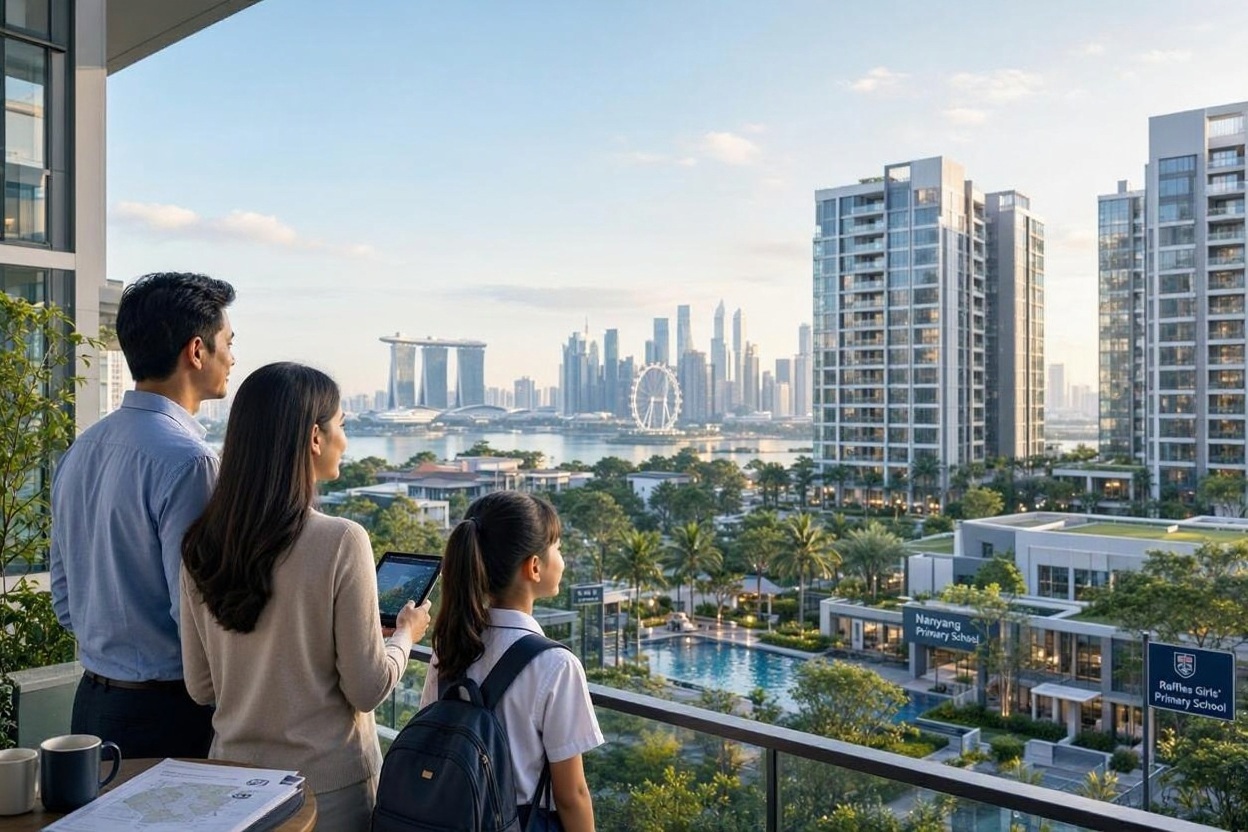
For families purchasing a condominium in Singapore, access to suitable schools can be an important part of the decision-making process. Parents often consider educational facilities alongside transport connections, neighbourhood amenities and the overall suitability of a residential development.
Living near a school may simplify daily routines, reduce travelling time and provide children with easier access to educational activities. However, school proximity should not be confused with guaranteed admission. Singapore’s school placement system follows specific registration rules, eligibility conditions and priority considerations.
For parents exploring properties in northern Singapore, understanding how school locations influence residential decisions can help narrow down suitable neighbourhoods.
1. Why School Location Matters in Property Selection
A family’s daily schedule can be heavily influenced by the location of its children’s schools.
Long commuting distances may require parents to spend additional time arranging transport, especially when children attend different educational institutions. A home situated within a convenient distance of school facilities can make morning and afternoon routines more manageable.
School accessibility can also affect the choice of transport. Some families prefer walking routes, while others prioritise nearby bus services or MRT connections.
However, parents should consider more than the distance shown on a property map. Pedestrian safety, sheltered walkways, road crossings and traffic conditions are equally relevant.
It is worth visiting the surrounding streets during school opening and dismissal periods to understand how busy the neighbourhood becomes.
2. Understanding Singapore’s Primary School Registration System
One common misconception among property buyers is that purchasing a home close to a particular primary school guarantees a place for their child.
This is not the case.
Singapore’s primary school registration exercise follows a structured system involving different registration phases. Priority is determined by factors such as citizenship, existing school connections and home-to-school distance.
For relevant registration phases, the distance between the registered residential address and the school is an important consideration.
Parents should consult the Ministry of Education (MOE) for the latest registration arrangements, eligibility requirements and school information.
Another important point concerns residential address requirements. Families should understand the applicable conditions before relying on a property purchase to improve their child’s school registration prospects.
A nearby school may be convenient, but buyers should never assume that proximity alone guarantees admission.
3. Evaluating Family-Friendly Neighbourhoods in Yishun
Yishun is an established residential town with a range of educational institutions, shopping facilities and public transport connections.
Families can explore schools within the neighbourhood while considering their children’s educational stages and preferred learning environments.
The area also provides access to Northpoint City, neighbourhood retail facilities and healthcare services. These amenities can help reduce the need for lengthy journeys when handling everyday family responsibilities.
One planned residential development in the district is Chencharu Central Residences, a private mixed-use condominium at Chencharu Close in District 27.
The development is being undertaken by Gamuda Land, Evia Real Estate and Ho Lee Group. It is planned as a 99-year leasehold project with up to approximately 875 homes.
Its proposed components include a hawker centre, bus interchange and retail facilities. Khatib MRT is approximately 0.45 to 0.49km away.
For parents considering this location, the combination of residential accommodation and proposed everyday amenities may be worth examining. However, they should independently check the actual distances to their preferred schools and assess the available transport routes.
4. Why Sembawang May Appeal to Growing Families
Sembawang offers another residential environment for parents evaluating northern Singapore.
The neighbourhood has established housing estates, recreational facilities and access to the North-South Line. Families can examine nearby schools while considering how easily children can travel between home, school and extracurricular activities.
Green spaces may also contribute to a more balanced family lifestyle. Parks and cycling routes offer opportunities for outdoor activities without requiring residents to travel far from their neighbourhood.
An upcoming development in the area is Fablewoode Residences, an executive condominium planned along Sembawang Road in District 27.
Developed by Oriental Pacific Development, it is expected to comprise approximately 265 low-rise homes on a 99-year leasehold site. Canberra MRT is approximately 0.5km away, and the development is next to the Sungei Simpang Kanan park connector.
Families interested in this location should investigate nearby educational facilities, admission considerations and actual travelling times before making a purchase decision.
The development’s launch date, pricing and floor plans have not yet been confirmed.
5. Five Factors Parents Should Check Before Buying
School proximity is only one element of a suitable family home. Parents should evaluate the following considerations before committing to a property.
- School suitability: Research the school’s programmes, educational approach and available facilities rather than choosing based solely on distance.
- Admission requirements: Review the latest MOE registration phases and priority rules.
- Transport arrangements: Check whether children can walk safely, take a bus or use the MRT independently when appropriate.
- Future educational needs: Consider whether the neighbourhood offers access to suitable institutions as children progress through different educational stages.
- Household affordability: Ensure that mortgage repayments, maintenance fees and other ownership expenses remain manageable.
Parents should also consider the property’s internal layout. Bedrooms, storage space, study areas and common living spaces can become increasingly important as children grow older.
6. Balancing Education with Other Lifestyle Priorities
A family home should support more than school attendance.
Parents may also value access to supermarkets, healthcare facilities, sports amenities, parks and community spaces. These features can influence how comfortably a household manages everyday responsibilities.
Employment locations should also be considered. A property that is close to a school but creates an unnecessarily difficult commute for working parents may not offer the best overall arrangement.
The most practical approach is to create a list of household priorities and compare several neighbourhoods against those requirements.
Conclusion
Choosing a condominium near suitable schools can make family life more convenient, but parents should approach the decision carefully. School admission is governed by MOE policies, and residential proximity does not guarantee placement.
Yishun and Sembawang offer different residential environments worth exploring. By assessing educational access alongside transport, amenities, property layout and affordability, families can make a more balanced housing decision.